
Some 16 years after China first showcased drones in a military parade, there is keen interest in how the People’s Liberation Army has developed its uncrewed systems, and how they will be displayed during Beijing’s military parade on Wednesday.
Analysts say the breadth and variety of drone systems expected at China’s coming military parade could underscore the PLA’s rapid advances in integrating autonomous technologies across air, land and sea, signalling a shift towards AI-enabled, multi-domain operations.
While previously unseen models might be revealed, and could be presented in mixed formations to reflect combat scenarios, including their AI-assisted abilities, experts tend to believe the systems will still be shown in static displays instead of in motion for security reasons.
On Wednesday, September 3, China is set to hold its largest military parade, marking the 80th anniversary of victory in World War II, with officials last month pledging to unveil “new-domain forces and new-quality combat capabilities” that include advanced uncrewed systems.
For three consecutive weekends in August, Beijing staged large-scale rehearsals near Tiananmen Square. Although authorities have disclosed no equipment details, leaked photos of previously unseen systems have been circulating widely on social media, fuelling speculation among military observers.
Wu Zeke, deputy director of the Military Parade Leading Group Office, said certain “unmanned and counter-unmanned systems will be publicly displayed for the first time, highlighting the PLA’s strong capabilities to safeguard national sovereignty, security and development interests, as well as to maintain world peace”.
Among the uncrewed systems, aerial drones have attracted the greatest attention.
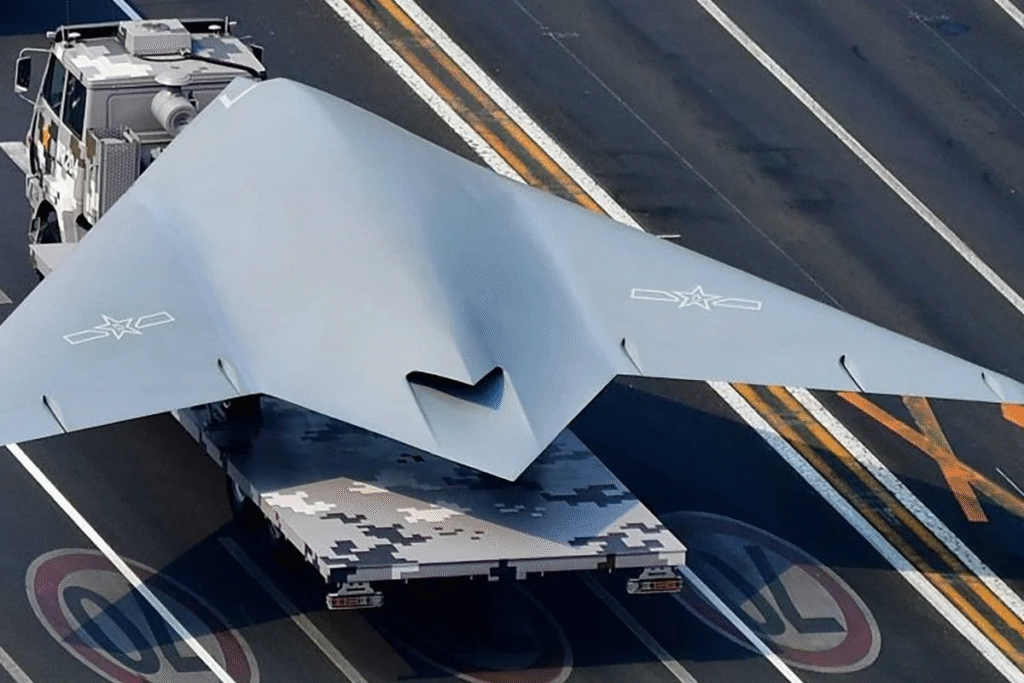
Satellite images that have surfaced in recent months suggest the PLA has a series of new drones, including one that looks like an FH-97 and at least five previously unseen tailless variations, according to military analysts. At least two were seen on mounted trucks during rehearsals last month.
The drones ranged from 9 metres to 12 metres (29-39 feet) in length with a wingspan between 6 metres and 11 metres. One had a conventional wing-tail design and four had modified diamond-delta wings – much like one that was spotted flying alongside Y-8/Y-9 transport aircraft.
All appear to be stealth unmanned combat aerial vehicles (UCAVs) comparable to the US Air Force’s Collaborative Combat Aircraft under its Next Generation Air Dominance programme. China has already announced several “loyal wingman” types, including the FH-97 and FH-97A, which can be controlled by twin-seat J-20S stealth fighters.
One of the most anticipated UCAVs is an upgraded GJ-11 Sharp Sword, which has been spotted airborne on several occasions.
A static standard GJ-11 was shown in the 2019 parade but was not carrier-capable. Since then, there has been evidence of a naval variant, dubbed GJ-11J, with mock-ups seen at a training site near the Type 076 amphibious assault ship Sichuan in May and at a full-scale aircraft carrier test facility in the central city of Wuhan in December 2023.
Photos of an airborne GJ-11 emerged shortly after the catapult-equipped Sichuan – which state media have consistently described as a drone carrier – was launched, suggesting a link.
An armed navalised GJ-11 would represent a capability not found anywhere else in the world, including the US Navy. Rear Admiral Michael Donnelly said in April that the Americans had deferred any such plans to an unspecified date beyond the 2030s.
In addition to aerial drones, armed robotic ground systems – formally known as quadruped unmanned ground vehicles (Q-UGVs) – are also expected to be on show.
Last month, state broadcaster CCTV aired the first detailed PLA footage of crewed-uncrewed drills involving drone swarms and armed robot wolves.
In July, CCTV footage showed the PLA Western Theatre Command’s 76th Group Army deploying dozens of 68kg (150lbs) robot wolves mounted with assault rifles as scouts, shooters and ammunition carriers during mountain exercises near the Russian border.
These platforms, developed by China South Industries Group and unveiled in November, showed 100-metre precision strikes, an upgrade over the robot dogs used in drills in Cambodia since 2024.
Former PLA instructor Song Zhongping said the significance of this week’s parade was not in individual weapons but in the integration of systems.
“My main attention will be on how the PLA displays the combination of uncrewed assets, with each service having its own systems matched to its combat structure. This creates a networked operational capability,” Song said.
“Any single weapon is merely a tactical asset, one link in a wider system that extends the battlefield, reconnaissance reach and strike options. Uncrewed systems complement crewed ones, and in the future will replace them in more urgent, dangerous and demanding tasks.
“We are now in a critical stage of transition and integration between the two.”
Unlike past parades where drone systems were listed as equipment, the PLA described this year’s parade formation at the August briefing as “organised according to real-combat joint groupings”, suggesting cross-system operational readiness.
Wu said one of the highlighted features of the parade design was a dedicated formation for new platforms, such as advanced unmanned aerial vehicles.
Michael Raska, assistant professor at the Military Transformations Programme at Singapore’s Nanyang Technological University, said the PLA’s concept of “unmanned intelligent systems” reflected a push to embed AI and autonomy across all domains as part of “intelligentised” warfare.
“This is not just about individual platforms, but about building an AI-driven force. Loyal-wingman UCAVs, swarming loitering munitions and unmanned ground vehicles are all part of this vision,” he said.
The steady progress in uncrewed systems development can be seen in the previous two PLA parades.
In 2015, the event focused on strategic missiles and included limited uncrewed displays, while the 2019 parade provided the stage for China’s first dedicated UAV formations, three in total, including the notable debut of the GJ-11 attack drone, the WZ-8 supersonic reconnaissance drone and the HSU001 unmanned underwater vehicle.
Quadruped uncrewed systems, or robot dogs, have been absent in previous parades, but their recent appearance in military outlets have drawn attention.
India’s Army Day in January was the first major military parade to feature robot dogs, followed by the US Army’s 250th anniversary parade in June. In both cases, they were unarmed and marched alongside human personnel.
Despite speculation that the PLA would show uncrewed systems manoeuvring in and about Tiananmen Square, Song said static displays were more likely because of safety concerns.
“The parade must ensure absolute safety, stability and reliability. These weapons have already been showcased in training and exercises through released footage,” Song said. “Their presence alone will shock and deter the world.”
Raska said any flyover by loyal-wingman drones would aim to signal confidence in technological maturity, even if they were unproven in PLA service.
“Beijing has a long track record of using military parades to blur the line between ambition and operational reality, projecting maturity to domestic audiences and potential adversaries alike,” he said.

