
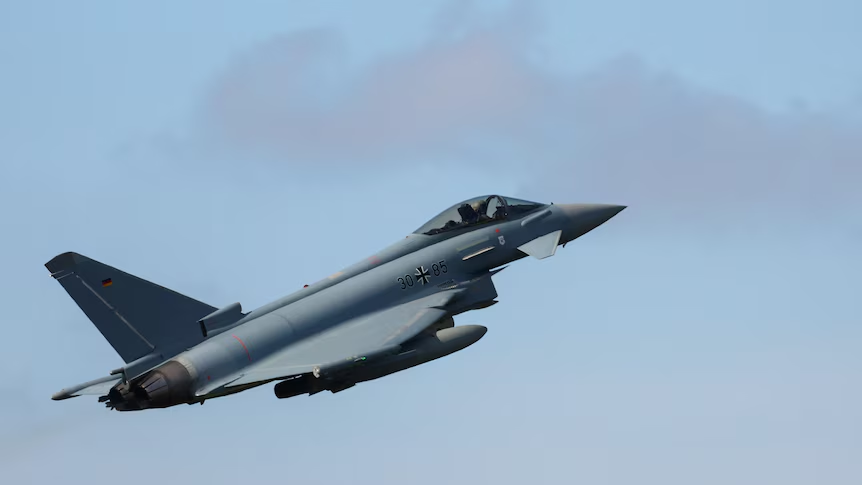
Germany has sent planes to track a Russian military aircraft after it was intercepted flying without a plan or radio contact in a neutral airspace over the Baltic Sea.
The German Air Force said its “quick reaction alert force”, ordered by NATO on Sunday, came amid rising tensions in the region following Moscow’s incursion into Estonia’s airspace in recent days.
Russian jets were observed flying in Estonian airspace for 12 minutes on Friday, an incursion condemned by President Donald Trump.
President Donald Trump on Sunday said he would defend the EU members and Baltic states if Russia intensified hostilities.
When asked by reporters, Mr Trump said: “Yeah, I would. I would.”
The incident has prompted an emergency meeting of the UN Security Council on Monday.
The two German Eurofighters handed the Russian IL-20m military aircraft escort over to NATO partners in Sweden.
Poland also accused the Kremlin of deploying jets to fly over polish-owned gas drilling facilities in the Baltic.
Earlier this month, Polish military shot down suspected Russian drones after repeated violations of its airspace during an attack on Ukraine.
“NATO airspace will be defended,” Mr Healey said in a statement.
The European Union said the three Russian MiG-31 fighters that violated Estonian airspace over the Gulf of Finland triggered complaints of a dangerous new provocation.
Moscow denied the incident.
Italian F-35 fighters attached to NATO’s mission, along with Swedish and Finnish aircraft, were scrambled to intercept the Russian jets and warn them off.
Professor Matthew Sussex for Strategic and Defence Studies at the Australian National University said there were two reasons why Russian President Vladimir Putin had ramped up airspace incidents.
“One is to distract attention from the war in the Ukraine by effectively saying the main threat is to NATO,” he told ABC News Channel.
“The second reason is that Putin wants to test the strength of NATO’s unity, particularly with what the Trump White House is prepared to back.”
After Mr Trump was briefed on the situation in Estonia, he said, “We don’t like it.”
His statement came about two weeks after some 17 Russian drones violated Polish airspace, an incident Mr Trump then sought to downplay.
“It could have been a mistake,” Mr Trump told journalists on September 11.

