
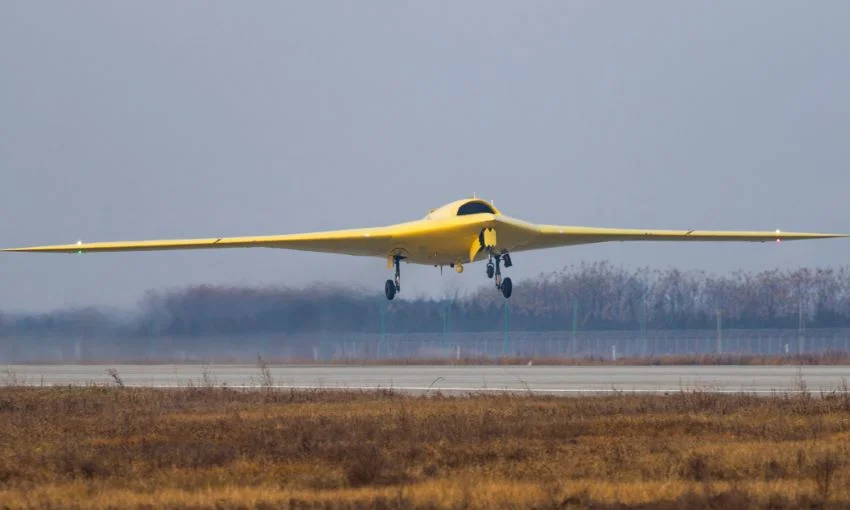
Beijing (TDI): China’s latest high-altitude, high-speed drone, the CH-7, successfully completed its first flight at an airfield in Northwest China, marking a key milestone in the aircraft’s development, the 11th Academy of China Aerospace Science and Technology Corp (CASC) confirmed on Monday.
The CH-7, a large flying-wing drone, has attracted attention since its public displays at Airshow China. Designed with a high-aspect-ratio tailless flying-wing configuration, it is capable of carrying advanced payloads, including visible light and infrared sensors, for long-duration reconnaissance and data support missions under complex conditions, according to Global Times.
CASC engineer Li Jianhua emphasized that the maiden flight is a critical step for any new aircraft. “The primary goal was to validate the rationality of the design and test the key technological breakthroughs. Given the CH-7’s complex aerodynamic configuration and challenges with directional stability, the risks were relatively high,” Li said.
During the initial flight, engineers tested basic functionalities including autonomous taxiing, takeoff and landing, attitude control, and trajectory tracking. The results met all design specifications and simulation predictions. Subsequent tests will focus on flight performance, endurance, and payload operations.
Read More: China’s Economy Maintains Steady Growth in November
The CH-7 has been featured at multiple editions of Airshow China, with its first full airframe unveiled in 2024. Its top-mounted engine intake, semi-concealed exhaust nozzle, and clean, streamlined flying-wing design optimize both aerodynamic efficiency and stealth performance. The drone incorporates radar-absorbing materials along leading edges, stealth coatings on its surfaces, and specialized treatments for access panels, landing gear bays, weapon bays, and even screws, giving it exceptional low observability.
According to experts, the CH-7 is designed primarily for reconnaissance rather than direct combat support. Its high stealth, long endurance, and advanced sensors allow it to operate ahead of conflict zones for surveillance, intelligence collection, and target designation for long-range precision strikes. Demonstrations suggest it can monitor maritime areas, relay data to command centers, and guide follow-on strike platforms while remaining largely undetected.
Read More: World’s Largest Ice and Snow Theme Park to Open in China
While its flight speed is slower than modern fighter jets, the CH-7’s capabilities in prolonged, covert reconnaissance make it a valuable asset for informatized warfare and modern symmetric combat scenarios, enhancing situational awareness and supporting precision strike operations.

