
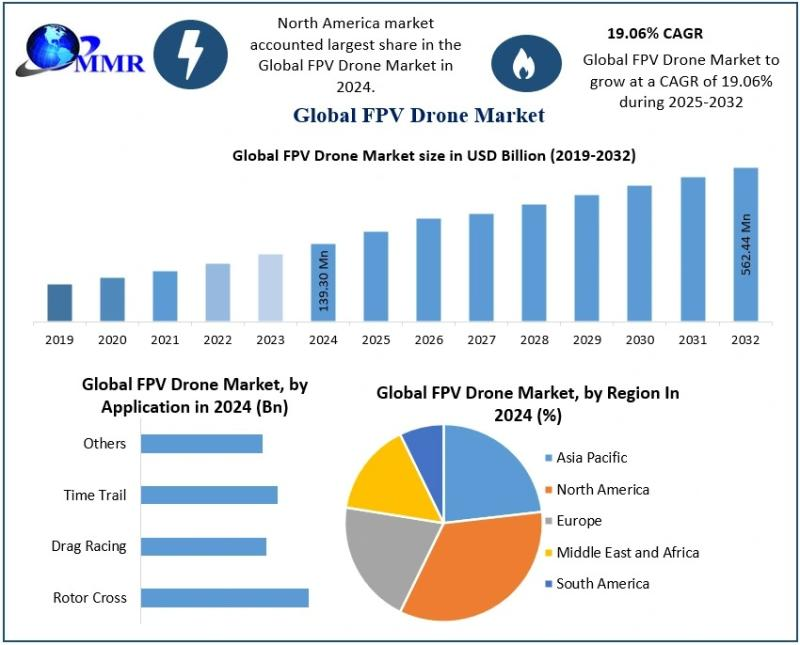
Global FPV Drone Market is projected to grow rapidly through 2032, fueled by immersive technology, drone racing, and commercial applications.
Opening Paragraph:
According to a recent study by Maximize Market Research, the global FPV (First-Person View) Drone Market was valued at USD 139.30 million in 2024 and is forecast to reach USD 562.44 million by 2032, expanding at a compound annual growth rate (CAGR) of 19.06% during 2025-2032. The growth is propelled by expanding commercial use, rising popularity of drone racing, and advancements in flight control, battery performance, and real-time video transmission technologies.
Key Highlights:
Market Size & Growth: From USD 139.30 million (2024) to USD 562.44 million (2032) at 19.06% CAGR.
Leading Segment: FPV cameras remain the largest component segment due to their role in live streaming and flight control.
Top Application: Commercial and entertainment applications dominate, including drone racing, filmmaking, and inspection.
Fastest-Growing Region: North America leads the global market, supported by technological innovation and regulatory progress.
Key Drivers: AI integration, 5G connectivity, miniaturization of components, and immersive flight experiences.
Major Players: DJI, Fat Shark, BetaFPV, iFlight, EMAX, GEPRC, Team BlackSheep (TBS), Holybro, and Diatone.
Market Outlook:
The FPV Drone Market is entering a dynamic growth phase, transforming from a niche hobby into a mainstream technology sector. FPV drones provide pilots with real-time video feeds through goggles or screens, enabling an immersive “first-person” experience. As flight control systems, video transmission, and image sensors advance, both consumer and professional segments are adopting FPV technology at an unprecedented rate.
Commercial adoption is accelerating in industries such as media, inspection, agriculture, and logistics. Filmmakers and content creators rely on FPV drones for smooth, high-impact aerial shots, while industrial users employ them for mapping, surveying, and maintenance in inaccessible areas. AI-enabled stabilization, automatic obstacle avoidance, and low-latency transmission systems are redefining operational safety and precision.
Technological innovations-particularly in battery efficiency and lightweight materials-are addressing the traditional constraints of flight time and range. As these issues improve, more applications are emerging beyond entertainment and racing. Start-ups are introducing modular FPV systems and customizable drone kits, expanding accessibility for new users.
Regional Insights:
North America is projected to maintain the largest market share through 2032, supported by early adoption, a mature consumer base, and investment in drone racing and entertainment industries. The United States leads with robust drone manufacturing and a well-developed ecosystem for aerial filming and sports events.
Europe is witnessing steady growth, bolstered by advancements in drone regulations and widespread adoption in cinematography, defense, and agriculture. EU policies that standardize safety and operational rules are fostering innovation and commercial usage.
Asia-Pacific is expected to experience the fastest growth due to a combination of large-scale manufacturing capabilities, rising consumer interest, and government support for drone technology. Countries such as China, Japan, and South Korea are emerging as key manufacturing hubs.
Other regions, including Latin America, the Middle East, and Africa, are showing increasing potential as drone accessibility improves and awareness of FPV applications expands.
Key Players and Competitive Landscape:
The FPV Drone Market is moderately fragmented, featuring both global and specialized manufacturers. DJI dominates with advanced camera and control technologies, while niche brands like BetaFPV, Fat Shark, GEPRC, and iFlight cater to racing and enthusiast communities. Companies are investing heavily in AI integration, image sensors, enhanced transmission, and 5G compatibility to strengthen their market positions.
Collaborations and product launches are shaping competitive strategies. For example, drone makers are partnering with software firms to enable cloud-based flight analytics and AI-driven automation, while racing drone producers focus on lightweight design and real-time FPV performance. As the cost of FPV equipment decreases, market competition is expected to intensify.
Market Challenges:
Despite rapid progress, several factors could hinder market expansion:
Regulatory Limitations: Inconsistent drone operation laws across regions restrict large-scale deployment.
Battery and Power Limitations: Short flight times continue to challenge long-range and professional use.
For full access to the data, request a sample report now : https://www.maximizemarketresearch.com/request-sample/211053/
Safety and Privacy Concerns: Public perception and airspace safety remain critical regulatory considerations.
Environmental Impact: Concerns about material waste, noise, and wildlife interference are increasing.
Addressing these barriers through improved safety systems, better battery chemistry, and standardized global regulations will be key to sustaining growth.
Analyst Quote:
FPV drones are evolving from hobbyist tools to industrial assets,” said Alex Kumar, Senior Analyst at Maximize Market Research. “As immersive flight technology merges with AI and 5G, the market will experience exponential adoption across industries-from media production to infrastructure monitoring.

