
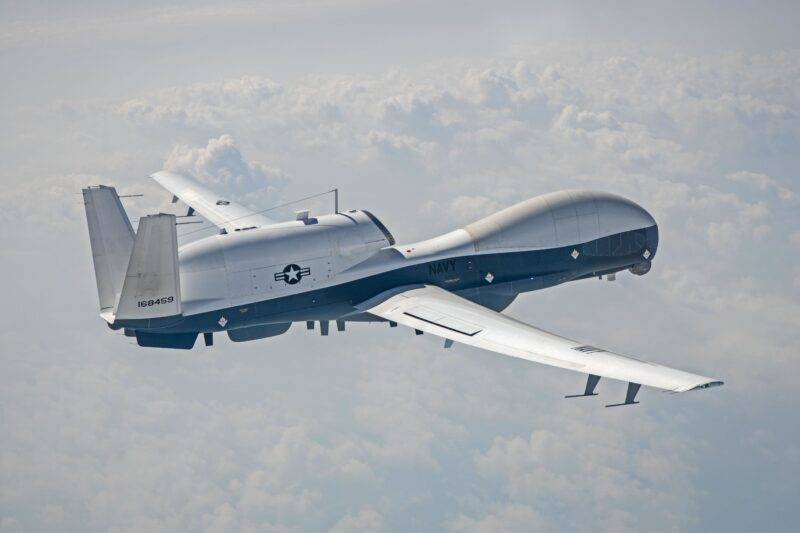
A United States Navy MQ-4C Triton long-range intelligence aircraft conducted an extended surveillance mission over the Caribbean Sea on 8 January after departing Naval Station Mayport, according to publicly available flight-tracking data.
The aircraft, identified as MQ-4C Triton number 169659 and flying under the callsign BLKCAT6, operated for roughly ten hours in international airspace north of Venezuela. The Triton maintained an altitude of about 47,000 feet while flying a repeated east-west reconnaissance pattern. The mission was visible on Flightradar24 before the aircraft left tracking range.
As noted in the flight data, the MQ-4C departed from Mayport, Florida, in the morning hours and entered its on-station track over the central Caribbean. The platform is capable of remaining airborne for up to 30 hours, allowing persistent intelligence collection across broad maritime areas.
According to the U.S. Navy, the MQ-4C Triton provides high-altitude, wide-area maritime surveillance for fleet commanders and is equipped with an advanced sensor suite designed to monitor surface activity, track vessels, and support maritime security operations.
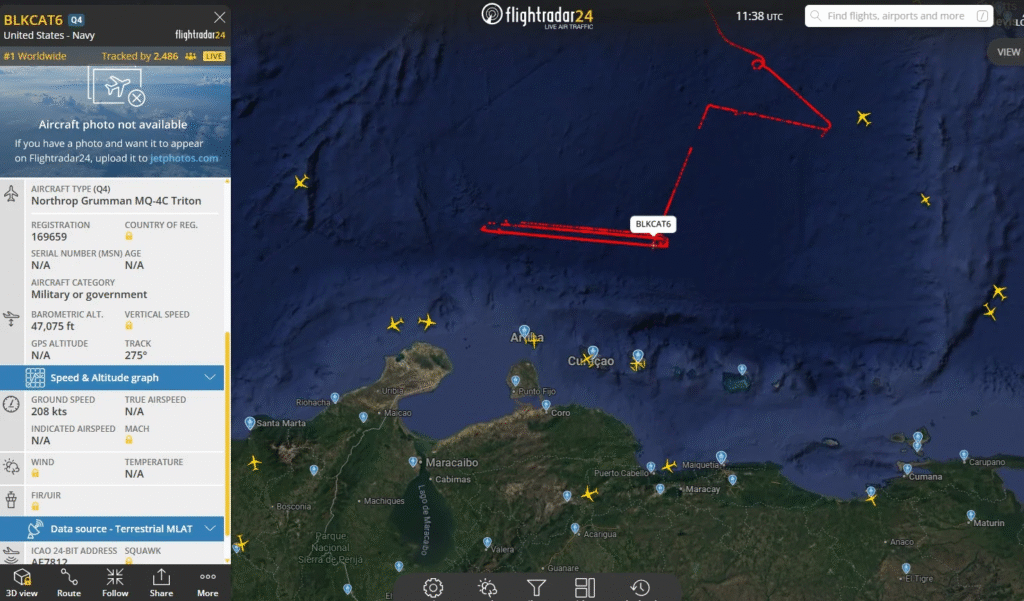
The aircraft spotted near Venezuela is part of the Navy’s expanding Triton deployment footprint across the Atlantic and Pacific theaters. Previous Navy statements have emphasized that Triton missions provide real-time intelligence to U.S. and allied naval forces during regional security operations.
Background information published by Naval Air Systems Command describes the MQ-4C as the service’s primary high-endurance unmanned reconnaissance asset. Built by Northrop Grumman, the aircraft uses a reinforced airframe, de-icing systems, and upgraded sensors to operate in adverse weather while maintaining constant maritime coverage.
The flight on 8 January comes during heightened U.S. monitoring of maritime activity near Venezuela as federal agencies continue enforcing sanctions against illicit oil shipments and vessels linked to restricted entities. The U.S. Coast Guard and Navy have increased coordination in the Caribbean since the start of the year.
The MQ-4C’s presence in the region underscores the ongoing U.S. emphasis on long-duration maritime intelligence collection to support interdiction efforts and safeguard sea lanes across the Western Hemisphere.

